
You’ll find a brief history of the Ben Lomond Quaker Center below. However, Quaker Center is very fortunate to have had a book written about its early years. John and Betty deValcourt were directors of Quaker Center in the early 1980s, and John wrote a history covering the Center’s origins through the devolvement from the American Friends Service Committee in 1982. The book is reproduced below in its entirety; let us know if you’d like us to mail you a copy.
The history of this land prior to European colonization
For over ten thousand years, the Awaswas people lived in and around this area. The Awaswas were an indigenous Ohlone-speaking group, made up of tribes near the Pacific Coast, alongside Monterey Bay, and at several places in the Santa Cruz mountains. The band nearest the inland scarp of the mountain where Quaker Center is now located were likely the Cotoni or Achistaca Awaswas. The arrival of the Spanish, and ongoing European colonization brought genocide and devastating upheaval for the Awaswas and tribal groups across present-day California. The Awaswas were forced into mission systems in Santa Cruz, Santa Clara, and elsewhere, which decimated their people. There are no known living Awaswas speakers today. The Amah Mutsun Tribal Band, another Ohlone-speaking tribe that lived southeast of Quaker Center, works today through the Amah Mutsun Land Trust to preserve and revitalize the cultural heritage of the Awaswas and other Northern California indigenous groups.
Logging began in the San Lorenzo Valley at the end of the 18th century, and the industry came to dominate this area through the beginning of the 20th century. In a very short time, almost all of the Valley’s old growth redwoods had been cut down and used for construction or burned in lime kilns to make cement. Timber concerns left only when almost all the limestone and usable trees had been harvested or, in some cases, protected. Big Basin Park, just north of Ben Lomond, was California’s first state park and declared a reserve in 1902.
1920 – 1949: the Manley era, and the donation of land
In 1920, Clyde and Lucile Manley purchased the original parcel where Quaker Center’s central campus is today. They almost certainly purchased it from a logging interest, which in turn may have purchased it from another logging company, as the hillside has been clearcut more than once. The Manleys lived here for 30 years, planting the orchard and building several buildings. Clyde passed away in 1947, and in 1949 Lucille donated the land, then about 51 acres, to the College Park Association of Friends (now College Park Quarterly Meeting). College Park passed the ownership to the American Friends Service Committee. The Manleys, who were not Quaker, were inspired by the work of Friends that California Quakers would use the land ‘for the enjoyment, betterment, education and welfare of [human]kind.’
Edith Cold was Lucile Manley’s sister, and she lived with the Manleys for many years on this land. Ms. Cold was an extraordinary person – a missionary, teacher, activist, poet and journalist, and almost surely the family’s connection to the Quaker peacework of the day, through her years as a missionary and at the Pine Mountain Settlement School in Harlan County, Kentucky in the 1930s and 40s. You can read more about Edith Cold’s remarkable life at the Edith Cold Project website.
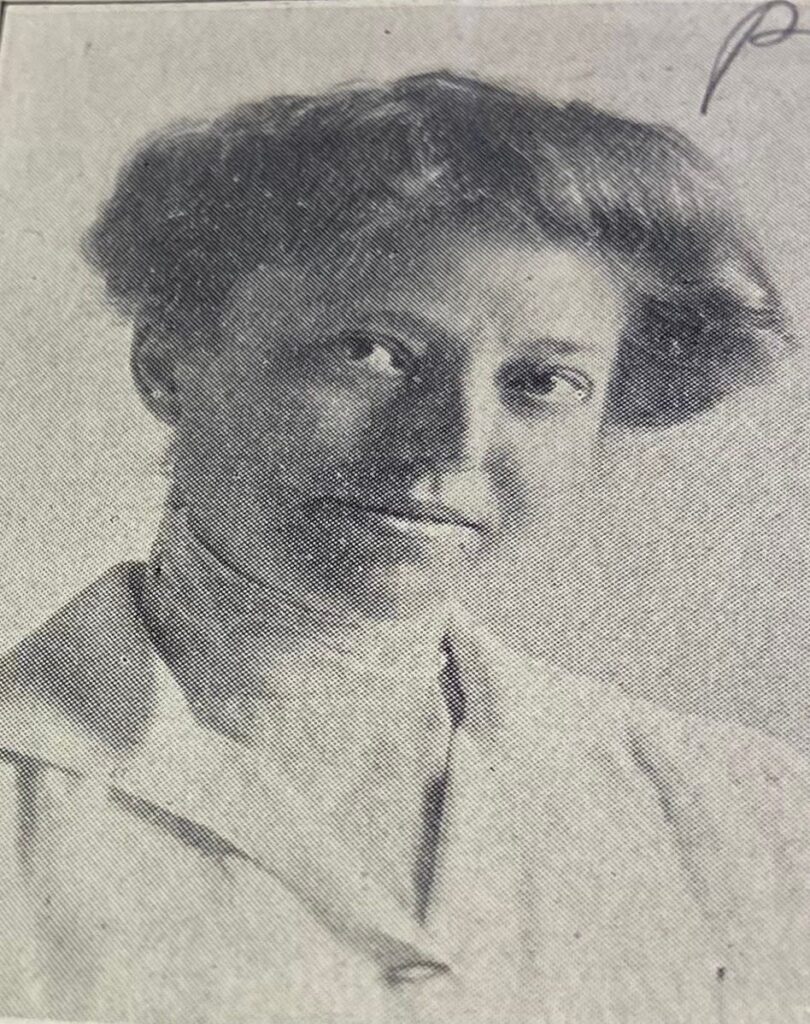
Edith Cold was Lucile Manley’s sister, and she lived with the Manleys for many years on this land. Ms. Cold was an extraordinary person – a missionary, teacher, activist, poet and journalist, and almost surely the family’s connection to the Quaker peacework of the day, through her years as a missionary and at the Pine Mountain Settlement School in Harlan County, Kentucky in the 1930s and 40s. You can read more about Edith Cold’s remarkable life at the Edith Cold Project website.
The early years at Quaker Center
Several pieces of history mark the first half of Quaker Center’s life:
- The legacy of the Cold sisters. Part of the terms of the donation of land were that Lucile Manley and her sister Edith Cold would be able to live as long as they liked at the new Friends’ center. And thus they did: Lucile stayed for almost 20 years, and Edith for 25. The first decades of life at Quaker Center were colored by the sister’s presence, participation and care.
- Camp Unalayee. In 1949, the very first summer after the donation of the land, Lucile Manley signed an agreement with Josephine Duveneck to operate, through the AFSC (American Friends Service Committee), an ‘interracial boys camp’ in the area where the Redwood Lodge now sits. The camp was first called Camp Ben Lomond and later Camp Unalayee. The camp ran for ten years, until it moved to the Trinity Alps, where Camp Unalayee still thrives today.
- Sequoia Seminar. In 1950, Quaker Center entered into a land-sharing agreement with a religious peace organization called Sequoia Seminar. In this agreement, Sequoia would build structures on the property and be able to use them for 15 years. They built the Orchard Lodge, the Casa de Luz, the maintenance house and the Haven. The long relationship with Sequoia included mutual support and frequent collaborations, but unfortunately narrowed to a dispute over the property use that was not completely resolved until the late 1970s. Sequoia Seminar, which has since dissolved, performed a lasting service in constructing these buildings that are used and cherished by so many.
The 1960s: Quaker Center programs. Friends activity at Quaker Center picked up in the 1960s, as it became the site of Friends’ gatherings of all sorts: Quaker programs, Meeting retreats, Quarterly Meeting sessions, Friends’ campouts and picnics, peace and nonviolence conferences, AFSC events and activities, and more. Over time, Quaker Center began to offer regular, organized Quaker programs – retreat workshops in which a facilitator would lead participants through the exploration of a theme over a weekend (or longer). In the 1980s, the first year-end retreats were held. All of these programs evolved over time, but have remained Quaker Center’s primary witness and offering: a gathering place and forum for Friends and many others to share their insight and experience with willing participants in transformative ways.
The 1960s: Quaker Center Hospitality. In the late 1960s, alongside its many Quaker activities, Quaker Center began opening its space to groups that needed conference and retreat space. Attracting a wide array of peace and social justice organizations, among others, the Center quickly became known as the perfect place for a group retreat. Far from the bustle of daily life, participants could share wider perspectives on their collective work, and connect deeply with one another. Finding awe, inspiration and the divine spark in the grandeur of the redwoods, visitors discovered more than a productive retreat, but transcendent experiences. The Center’s reputation grew not only as a peacework hub, but as an ideal place for spiritual growth and exploration for all visitors.
The 1970s: Devolvement from the American Friends Service Committee. The AFSC had been involved with the Center since the gift of the land was presented to Northern California Quakers. In 1979, the AFSC began the three-year process of handing the title and control of the center to the Ben Lomond Quaker Center Association. This is the Board that stewards Quaker Center today, and while it is an independent non-profit organization, it is under the spiritual care of College Park Quarterly Meeting.
The 1990s: Quaker Center Camps. In 1994, drawing on its roots of fifty years earlier, Quaker Center added a new overnight summer camp for children and younger teens to its activities. Like all Quaker Center programs, everyone would be welcome. The camp would combine traditional camp activities with service work and expressions of Quaker values. In 1999, the Center celebrated its fiftieth anniversary.
Quaker Center today. Quaker Center was shaped by this history, and continues to offer regular Quaker programs, a year-end retreat, Meeting retreats, and an overnight summer camp for children and young people. Today, Quaker Center also offers in-person and online programs, and daily, weekly and monthly worship. The center continues to offer lodging and meeting space to seekers of all kinds, and to many groups and organizations working towards a better world. In 2024, Ben Lomond Quaker Center celebrated 75 years of Friends presence in the Santa Cruz Mountain, and recommitted to its mission of nurturing the spiritual growth and faithfulness of Friends and others, while strengthening Quakerism and its witness in the world.
—
A Short History of the Early Years of Ben Lomond Quaker Center, by John de Valcourt, 2013.
- Introduction
- Before 1949
- 1949-1959
- 1960-1965
- The 1960s – Part Two
- 1970-1979
- The Early 1980s before Devolvement
- Devolvement from AFSC
- Quaker Center Chronology 1949-2012
- Appendix 1 – Sequoia Seminar
- Appendix 2 – Quaker Center Administration and Staff before 1982
- Appendix 3 – Glossary
- Appendix 4 – Bibliography