with Eric Lindner
an in-person program
May 15-17, 2026
friends, unfortunately, this program will not be held in May.
Integrity. Peace. Community. Equality. Stewardship. Simplicity.
Do the Quaker Testimonies have a home in the world of business?
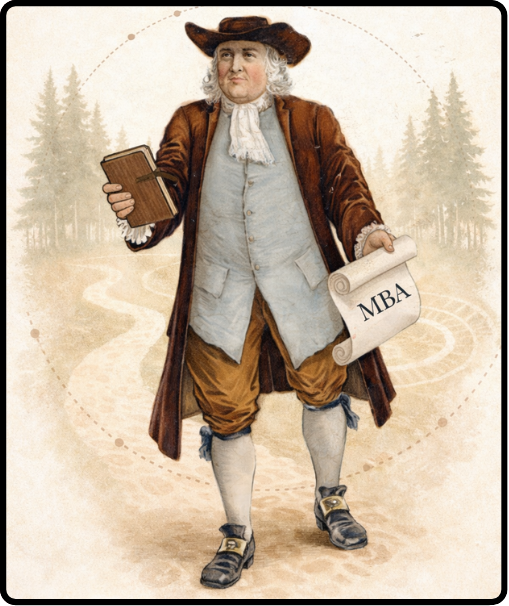
When Quaker Joseph Wharton founded The Wharton School at the University of Pennsylvania in 1881, it was the world’s first collegiate business school. Its purpose was both to train those engaged in commerce and to “prepare graduates with the breadth and depth of knowledge to become pillars of the State, whether in private or in public life.” In keeping with Wharton’s vision, at this program Eric will unpack the reasons why “business ethics” isn’t an oxymoron, and the Quaker Testimonies are an advantage in commercial affairs.
About the facilitator
Eric has spent most of his life in or around business. He has an MBA from The University of Chicago, teaches ethics at Georgetown University, and is active in the Central Coast Friends Meeting of the Religious Society of Friends (Quakers).
https://www.linkedin.com/in/eric-lindner-2129805a/

Who is this program for?
All are welcome to attend this program. Business students and those active in business and investing are especially welcome, but no business background or academic experience is necessary.
This will not be a lecture course with quizzes or grades – it will be a fun, participatory gathering of those interested in learning how Friends values can be applied to business.
You can learn more about what Quaker Center programs are like here.
Program cost
Like all Quaker Center programs, this program is priced along a sliding scale – we encourage you to contribute an amount that you are comfortable with and that enables you to attend. We hope the suggested cost ranges below will help you to do this.
Standard rate: $200-350.
Welcome rate: $75-150.
You can learn more about Quaker Center’s program costs here.
Childcare
Childcare will be provided during the program sessions.
More about ‘The Quaker MBA’
The Quaker MBA will offer an open, participatory exploration of how Quaker principles can shape the decisions we make in business, leadership, and investment. In the serene beauty of the redwoods, participants will engage in guided inquiry and roundtable discussion, progressing from foundations to practical frameworks and real-world application. Participants will examine how their values show up in real decisions—what they invest in, how they work, what they build, and how they lead. In our outward lives, do we orient our decisions around our values? Are we mindful or unconscious in the ways in which our external lives reflect our principles?
We will begin by grounding participants in the Quaker tradition: its history, testimonies, and enduring social and spiritual insights. From there, we’ll lay out a working understanding of the modern business landscape. Drawing from disciplines such as behavioral science, finance, law, operations, and strategy, participants will be encouraged to reflect on the core systems that govern how organizations function and how capital moves. This will not be an abstract overview—it will support participants in bringing their convictions into practice, whether by shaping a business they feel called to build or stewarding their financial resources in ways that open new possibilities for impact, integrity, and long-term flourishing.
From there, we will turn toward application. Through case studies, participants will examine how principles like integrity, stewardship, equality, community, simplicity and peace can function not only as ethical commitments, but as sources of competitive advantage over more shortsighted principles. The focus will be on practical, ethical viability: what works, what fails, and why. Participants will then be guided to articulate their own “unique value proposition”—clarifying how their particular skills, values, and context can be brought into alignment in their professional and personal lives.
Towards the end of the program, everyone will have the opportunity (but not the obligation) to “pitch” an idea they have to the group (to invest their money and/or time), and receive “discerning feedback.”
We will conclude with a capstone synthesis, offering a unifying framework for principled leadership and pointing toward further leaders worth studying. Participants will leave not just with ideas, but with a clearer approach to making real decisions, one that treats their principles not as limits, but as sources of direction, opportunity, and prosperity for our planet and for future generations.